Mercyful Fate Melissa Guitar Intro Solo Lesson: How to Play It (With TAB Examples)

Learn the techniques and music theory behind one of Mercyful Fate's most melodic guitar solos.

The introduction to "Melissa" by Mercyful Fate contains one of the band's most expressive lead guitar moments. Rather than relying on speed alone, the solo combines melodic phrasing, expressive bends, legato playing, and the haunting sound of the D harmonic minor scale to create its unmistakable atmosphere.
In this lesson, we'll break down the ideas behind the solo, look at a few important TAB examples, and discuss the techniques that make it sound authentic.
Note: This lesson focuses on teaching the concepts behind the solo rather than providing a complete transcription. Watching and listening carefully is an important part of learning expressive lead guitar.
Listen to the Rhythm Guitar First
Before learning the lead guitar, it's worth understanding what's happening underneath it.
The introduction revolves around a simple arpeggiated progression beginning with a Dsus2 chord before moving through changing bass notes.
Instead of thinking of the solo independently, listen to how every phrase relates to the harmony beneath it. This makes it much easier to understand why certain notes sound stable while others create tension.
The Secret Behind the Solo: Two Minor Scales
One of the most interesting aspects of this solo is that it doesn't stay in a single scale.
Instead, it alternates between:
D Natural Minor
D Harmonic Minor
The only difference is the seventh scale degree.
D Natural Minor
D – E – F – G – A – Bb – C

D Harmonic Minor
D – E – F – G – A – Bb – C♯

That raised seventh (C♯) is responsible for the dark, almost Middle Eastern flavor heard throughout the solo. The guitarist constantly switches between the C natural and C♯, creating the dramatic tension that gives Melissa its unique sound.
Example 1: The Opening Bend
The solo immediately establishes its expressive style with a whole-step bend before descending through notes from the D harmonic minor scale.

Notice how the bend isn't simply about reaching the pitch—it's about matching the vocal quality of the original recording.
Stay on the B and G Strings
A common mistake is trying to play the solo entirely in one scale box.
While that's possible, the original performance stays primarily on the B and G strings, moving up and down the neck instead. This produces a smoother tone and allows the phrasing to sound much closer to the recording.
Example 2: The Harmonic Minor Phrase
One of the defining phrases uses the raised seventh (C♯) before resolving back to D.
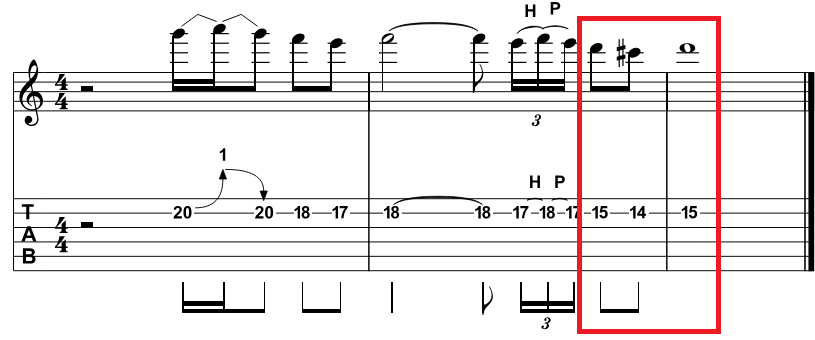
That half-step pull toward the tonic is what gives harmonic minor its unmistakable sound.
Legato Is Everywhere
Much of this solo relies on hammer-ons and pull-offs instead of picking every note.
Rather than treating them as ornaments, Mercyful Fate uses them as part of the melody itself.
When practicing:
Make every hammer-on as loud as a picked note.
Pull off with enough force that the following note rings clearly.
Practice slowly before increasing speed.
You'll hear these techniques repeated throughout the solo.
Don't Ignore Your Pinky
Another valuable lesson from this solo is finger choice.
Many guitarists avoid using their fourth finger whenever possible, but several passages become much smoother when you incorporate it into your fingering.
Developing your pinky improves:
Reach
Dexterity
Speed
Overall efficiency
Using all four fingers opens up many more possibilities for future solos.
Example 3: Repeated Notes Create Tension
Toward the middle of the solo, repeated notes help build anticipation before the melody continues.

Don't rush these repeated notes. Their rhythmic placement is just as important as the pitches themselves.
Pay Attention to Articulation
If there's one thing to listen for when learning this solo, it's the articulation.
Focus on:
Smooth bends
Controlled vibrato
Hammer-ons
Pull-offs
Repeated notes
Slides
These details often matter more than simply playing the correct frets. As I mention in the video, slowing the recording down and watching the finger movements carefully is one of the best ways to capture the original feel.
Final Thoughts
The intro solo to "Melissa" is an excellent study in expressive metal lead guitar. Although it's rooted in D minor, the use of D harmonic minor, melodic phrasing, and careful articulation makes it one of Mercyful Fate's most memorable solos.
Rather than memorizing notes, spend time understanding why each phrase works. Learning the scales, listening for the change between natural minor and harmonic minor, and practicing the articulation will help you apply these ideas to your own solos—not just this one.
If you'd like to learn classic metal solos, improve your lead guitar technique, or better understand the music theory behind the songs you love, Four on Six Music offers personalized online and in-home guitar lessons.
Frequently Asked Questions
What scale is used in the intro solo to "Melissa" by Mercyful Fate?
The solo primarily alternates between D natural minor and D harmonic minor, using the raised seventh (C♯) to create its signature dark sound.
Is the "Melissa" intro solo difficult?
It's generally an intermediate-level solo. The notes themselves aren't extremely fast, but expressive bends, hammer-ons, pull-offs, and accurate phrasing require solid technique.
Why does the solo sound different from a typical minor scale solo?
The frequent movement between natural minor and harmonic minor creates additional tension and gives the solo its distinctive neoclassical flavor.
Should I learn this solo entirely by TAB?
TAB is a helpful guide, but listening carefully to the recording is essential for capturing the bends, slides, vibrato, and phrasing that make the solo sound authentic.
Ready to Learn More?
Learning a solo like "Melissa" isn't just about memorizing notes—it's about understanding the techniques and musical ideas that make it so expressive. In this lesson, you've seen how Mercyful Fate combines D natural minor and D harmonic minor, along with bends, hammer-ons, pull-offs, and thoughtful phrasing to create a memorable guitar solo.
If you'd like personalized feedback on your technique or want help learning your favorite songs, I'd be happy to help.
At Four on Six Music, I offer one-on-one guitar lessons for students of all ages and skill levels. Whether you're interested in classic metal, rock, blues, jazz, classical, or music theory, lessons are tailored to your goals and designed to help you understand why music works—not just how to play it.
Lessons Available
🎸 In-home guitar lessons throughout Onondaga, Oneida, and Madison Counties in Central New York
💻 Online guitar lessons for students anywhere
🎵 Beginner through advanced instruction
🎼 Song-based lessons, lead guitar, rhythm guitar, improvisation, technique, and music theory
Ready to take your playing to the next level?
Book your lesson today and start building the skills to play the music you love with confidence.


Comments